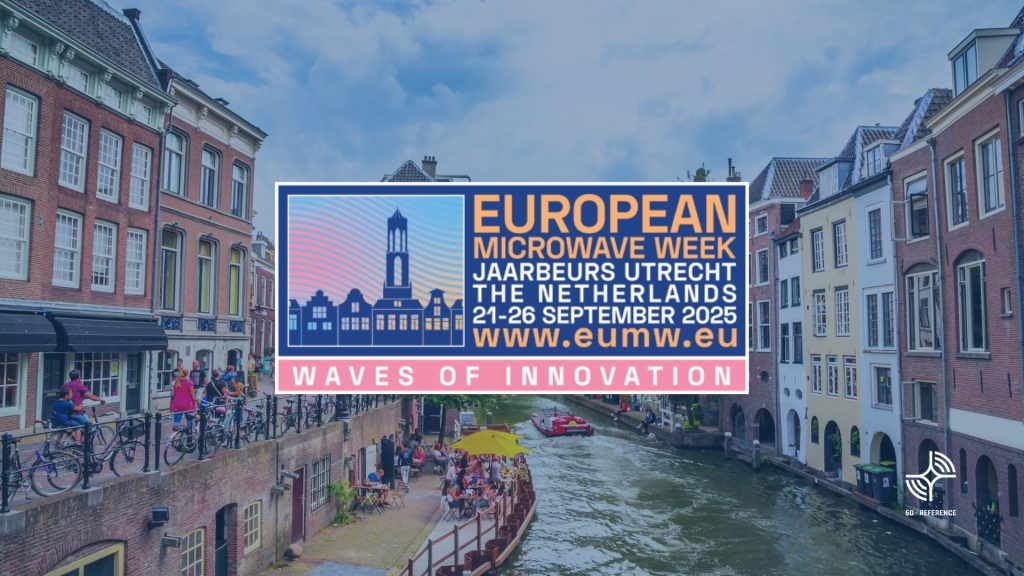
The 6G-REFERENCE project attended the European Microwave Week (EuMW) 2025, held from 21–26 September at the Jaarbeurs Convention Centre in Utrecht, the Netherlands, to present three scientific papers co-authored by several of our partners. As Europe’s premier event in microwave, Radio Frequency (RF), and wireless technologies, EuMW attracted over 1,600 delegates and 1,400 visitors from academia, industry, and research institutions.
Cutting-Edge 6G Research from ETH Zürich
On 22 September, researchers from ETH Zürich, one of 6G-REFERENCE’s partners, presented a paper during the EuMIC02 session: “Doherty Amplifiers and Linearizers for Communication Systems”. The talk, titled “An Ultra-Compact Ku-Band Doherty Power Amplifier with a Single-Footprint Triple Two-Turn Asymmetric Combiner for 6G FR3”, was delivered by Jinglong Xu, representing a team of authors including Edward Liu, Mohamed Eleraky, Tzu-Yuan Huang, Chenhao Chu, and Hua Wang, all affiliated with ETH Zürich.
The paper introduced a miniaturised, high-efficiency Doherty Power Amplifier (PA) designed for 6G Frequency Range 3 (FR3) Ku-band applications. Implemented in GF22 FDX+ technology, the PA achieves a PSAT of 21.51 dBm and a PAE6dB of 22.17% at 12 GHz, with the smallest reported Doherty combiner footprint in the Ku band (just 0.032 mm²). This breakthrough supports advanced 6G modulation schemes such as 64-QAM at 3800 MHz and 256-QAM at 1400 MHz, enabling data rates over 22 Gb/s, critical for future high-speed wireless systems.
University of Birmingham’s Presentation on Novel Work on Reconfigurable Surfaces
Further strengthening the 6G-REFERENCE project presence at EuMW, Rasoul Fakhteh, a PhD researcher at the University of Birmingham, presented his work on “Water-Controlled 1-bit Reconfigurable Surface” on 25 September, paper co-authored by Yi-Wen Wu and Yi Wang, during the EuMC42-2 session on Reconfigurable Intelligent Surfaces.
His oral presentation, held in the Spark Hall of the Jaarbeurs Convention Centre, drew attention from researchers, engineers, and industry representatives, with around 30–50 attendees.
Fakhteh’s paper explored a novel 1-bit metasurface architecture where the reconfiguration is controlled using water, introducing a potentially low-cost and energy-efficient approach to real-time surface manipulation in future 6G integrated sensing and communication (ISAC) environments.
Reflecting on his participation, Rasoul commented:
“Presenting my paper ‘Water-Controlled 1-bit Reconfigurable Surface’ at EuMW 2025 was an excellent opportunity to showcase our progress within the 6G-REFERENCE project. The conference enabled me to engage with leading experts in reconfigurable intelligent surfaces and metasurfaces, while also attending sessions that introduce novel concepts in many other areas. These interactions not only enriched my research perspective but also strengthened the collaborative vision of 6G-REFERENCE. The insights gained will directly support our goal of advancing reconfigurable technologies for 6G, with a focus on more adaptive, energy-efficient, and sustainable wireless systems. This participation has been a milestone in aligning our project’s objectives with the broader scientific community driving the future of communication.” – Rasoul Fakhteh, PhD researcher at the University of Birmingham.
CTTC and University of Birmingham’s Collaborative Microwave Sensor Innovation
Also, on Thursday 25 September, Zabdiel Brito-Brito, Researcher at our coordinator Centre Tecnològic de Telecomunicacions de Catalunya (CTTC), presented its innovative paper titled “Planar Low‑Cost Microwave Ring Resonator Temperature Sensor using a PDMS Active Layer” at EuMC49-3. This contribution showcases a promising proof‑of‑concept sensor that leverages a microwave ring resonator overlaid with a PDMS (polydimethylsiloxane) layer, whose temperature‑dependent dielectric properties cause a resonant frequency shift of approximately 1 MHz per degree Celsius, offering a cost‑effective, integrable sensing solution at around 4 GHz.
The scientific publication is a collaborative work of Zabdiel Brito-Brito, Jesús Salvador Velázquez-González, Fermín Mira and Ignacio Llamas-Garro, CTTC researchers, together with Yi Wang, Professor of Microwave Engineering at the University of Birmingham.

Bridging Research, Innovation, and Collaboration in 6G
Both contributions reflect 6G-REFERENCE’s core mission: to advance integrated sensing and communication technologies, with a particular focus on sustainability, adaptability, and reconfigurability for the next generation of wireless networks. Participation in events such as EuMW not only showcases the project’s technical advances but also fosters valuable exchange and collaboration with the broader scientific and industrial ecosystem.
As the global race toward 6G continues, 6G-REFERENCE remains at the forefront of shaping the future of communication.
More About European Microwave Week
European Microwave Week 2025 (EuMWC 2025) brings the annual series of highly successful microwave events to Utrecht, the Netherlands. The European Microwave Week, where industry meets academia, is a six-day event that includes three innovative conferences, three forums and an exciting trade and technology exhibition with leading players from around the world.
EuMW 2025 provides access to the very latest products, research and initiatives in the microwave sector. It also provides participants with the opportunity to talk face-to-face with the people driving the future of microwave technology. The 28th European Microwave Week combines:
- The European Microwave Conference (EuMC).
- The European Microwave Integrated Circuits Conference (EuMIC).
- The European Radar Conference (EuRAD).
The conferences addresses a wide range of subject areas including: Microwave, Millimetre-wave and Submillimetre-wave Systems, Antennas and Propagation, Wireless Technologies, Telecommunication (RF, Microwave and Optical), ICs, Semiconductor Materials and Packaging, Radar Architectures, Systems and Subsystems, Sensors and Remote Systems, and Testing and Measurements.