When you hear about 6G, you might picture futuristic gadgets and lightning-fast speeds. But the true story of 6G is not just about what you can see. See it as a quiet revolution happening at the microscopic level, in the hardware that will turn tomorrow’s networks into living, breathing systems that can sense, think, and act in real time. Thanks to the Smart Networks and Services Joint Undertaking (SNS JU), a European public-private partnership driving research and innovation in advanced network technologies, pioneering research and innovation projects on topics such as advanced components, intelligent surfaces, and powerful chips.
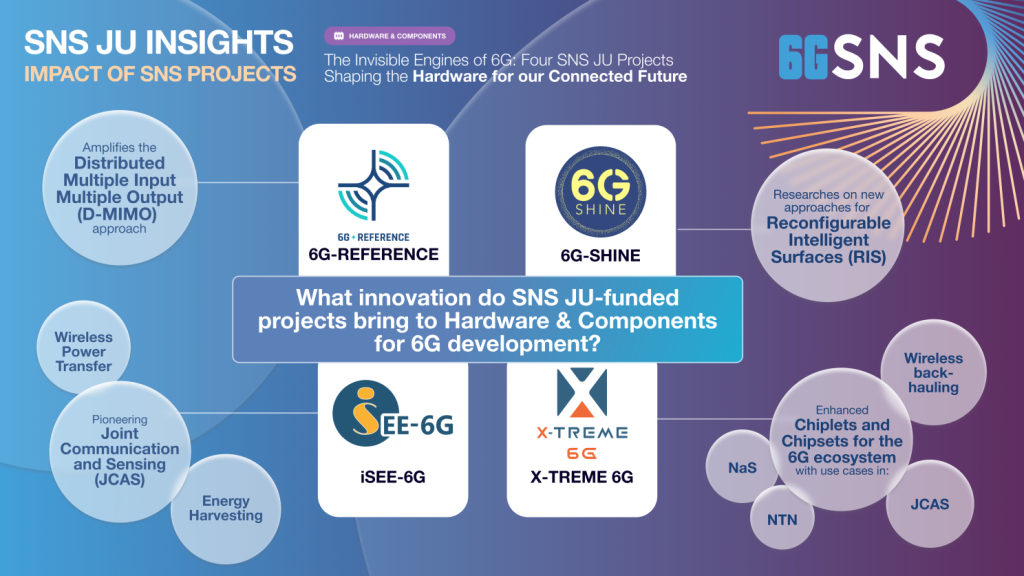
At the heart of this transformation is a new generation of hardware: the advanced components that make the magic of 6G possible. Four European projects, iSEE-6G, 6G-SHINE, X-TREME 6G and 6G-REFERENCE are at the forefront of this innovation, each contributing representing a vital piece to the 6G puzzle.
The Network that Sees: Joint Communication and Sensing
Imagine a drone flying over a disaster zone, not just sending back video, but also acting as a mobile base station, scanning the area with radar, and even powering sensors on the ground, all at once. This is the core idea behind Joint Communication and Sensing (JCAS), also known as Integrated Sensing and Communication (ISAC), a key technology for 6G.
Traditionally, communication and sensing have been separate worlds, each with its own hardware and radio frequencies. For example, your Wi-Fi router communicates, while your car’s radar senses. 6G is about merging these two functions into a single system, using the same hardware and radio signals. This is more than just a convenience; it is a game-changer.
The iSEE-6G project is pioneering this concept by not only integrating sensing but also adding wireless power transfer and energy harvesting. By developing advanced antennas and intelligent surfaces that combine these three functions, iSEE-6G turns a single radio wave into a multi-purpose tool. This unified approach is not only efficient (saving energy, reducing costs, and conserving the precious electromagnetic spectrum) but also enables life-saving applications like search and rescue or smart urban mobility. In short, drones and networks stop being separate tools and become partners that think and act together.
The Network that Thinks: Smart Surfaces and Distributed Antennas
But what happens when wireless signals hit a wall or a corner and get lost? That is where 6G-SHINE comes in, with its studies on Reconfigurable Intelligent Surfaces (RIS), ultra-thin panels that act like “programmable mirrors” for radio waves.
As we build more connected cities and industrial spaces, radio signals face an increasing number of obstacles, from tall buildings to large machinery. Instead of simply blasting a signal in all directions, 6G networks will be smarter. Unlike an ordinary metal reflector, a RIS can be programmed to direct a signal precisely where it is needed. The 6G-SHINE project has been researching this technology, which involves flat surfaces covered in tiny elements that can be electronically controlled to reflect, refract, or focus radio signals. For example, if a signal is blocked by a corner in a long corridor, a RIS placed at the turn can act like an adjustable mirror, bouncing the signal to the area beyond the obstacle. The result is a strong, reliable connection without the high-power consumption and signal delay of traditional repeaters. By electronically changing the reflection angle, a RIS can direct a signal precisely where it is needed, even in a crowded factory hall with many devices.
Another approach to creating a smarter network is to move away from a single, centralised cell tower. The 6G-REFERENCE project is focused on Distributed Multiple Input Multiple Output (D-MIMO), a “cell-free” approach where antennas are scattered across a wide area. Instead of one powerful base station, many smaller, low-power radios work together to provide seamless coverage. This method is especially effective in densely populated urban areas, ensuring consistent, reliable connectivity for everyone. By distributing antennas and using advanced synchronisation, D-MIMO improves network coverage, boosts capacity, and enhances energy efficiency, paving the way for more sustainable and affordable connectivity.
The Hardware that Fuels the Future: Chips and Chipsets
All these groundbreaking functionalities (sensing, intelligent surfaces, and distributed antennas), require powerful specialised hardware. This is where the X-TREME 6G project steps in. Their mission is to build the foundational microelectronics platform for a European 6G ecosystem.
The project is developing new kinds of chiplets and chipsets, the tiny, powerful components that are the brains of any electronic device. By leveraging Europe’s expertise in advanced semiconductor technologies, X-TREME 6G is creating hardware that can operate at the high frequencies needed for 6G. This hardware will enable a wide range of applications:
- Wireless Backhauling: simplifying the transmission of data between network towers to ensure high-speed, reliable internet.
- Non-Terrestrial Networks (NTN): powering low-earth-orbit satellites with robust hardware to bring instant connectivity to remote areas.
- Network as a Sensor: using the network’s inherent sensing capabilities to create a state-of-the-art environmental monitoring tool for things like hyper-accurate weather forecasting.
Oana Radu, Programme Officer at the SNS JU, emphasizes the strategic importance of these initiatives:
“These four projects exemplify how the SNS program is advancing Europe’s 6G capabilities from the hardware level up. By developing the fundamental components – sensing systems, intelligent surfaces, distributed antennas, and microelectronics – they are creating the building blocks for future networks. Crucially, their innovations are contributing directly to international standardization efforts, ensuring that European technology and values shape the global 6G landscape.”
A Smarter, Safer, and more Sustainable World
The combined efforts of these projects are creating a more intelligent, responsive, and connected world. The new components and hardware we are developing will enable AI-driven optimisation, lower energy consumption, and more reliable systems.
From the unified architecture of iSEE-6G that reduces complexity, to the smart, power-efficient surfaces of 6G-SHINE, to the scalable D-MIMO solutions of 6G-REFERENCE, and the foundational microelectronics of X-TREME 6G, each project is a beacon of innovation.
Together, we are shaping a 6G future that empowers people, devices, and industries to thrive, offering tangible benefits like improved public safety, smarter transportation, and a more sustainable, energy-efficient network for everyone.
To learn more about the projects, explore the links below:
- 6G-REFERENCE: Subscribe to the 6G-REFERENCE Newsflash, and follow the journey on LinkedIn, X and BlueSky.
- X-TREME 6G: Follow on Linkedin and visit the website.
- 6G-SHINE: Follow on LinkedIn, X, and check the website.
- iSEE-6G: Visit the website and follow on LinkedIn.
This article was originally published on the SNS JU Insights.