
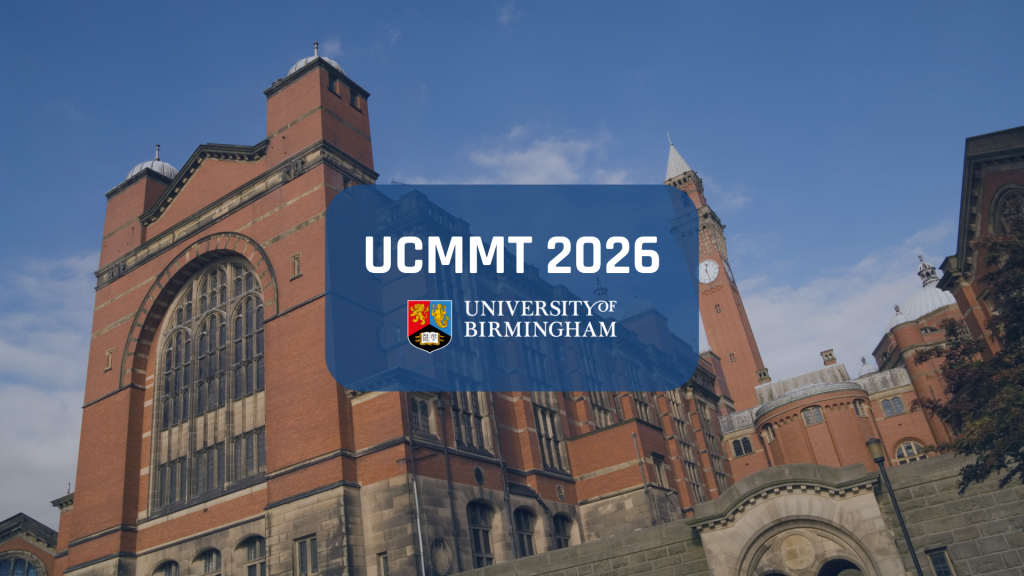
6G-REFERENCE participated in the 19th United Conference on Millimetre Waves & Terahertz Technologies (UCMMT 2026), held from 23 to 26 August 2026 at the University of Birmingham, one of the project partners, in the United Kingdom, delivering a paper presentation.
Rasoul Fakhteh Balasi, PhD candidate, shared his research on “A Reconfigurable PRS-Loaded Patch Antenna Enabled by Liquid Metal for Beam Steering” on 24 August 2026 at the University of Birmingham’s Edgbaston campus, also co-authored by Professor Yi Wang, and openly available on Zenodo.
The conference brought together researchers, academics, industry representatives, engineers and PhD students to exchange knowledge and discuss the latest advances in millimetre-wave and terahertz technologies.
Sharing 6G-REFERENCE Research with the International Community
The presented research addresses the development of reconfigurable antenna technologies based on liquid metal, with a particular focus on beam-steering capabilities. The work demonstrates a low-profile, liquid-metal-integrated partially reflective surface (PRS) antenna capable of steering its beam from −50° to +50°, while maintaining stable impedance performance across different reconfiguration states.
The conference provided a useful platform to discuss the potential of fluidically reconfigurable structures and to position this research within the wider development of adaptive antenna technologies. This participation also helped increase the visibility of the 6G-REFERENCE project and its contribution to the development of reconfigurable technologies for future 6G wireless systems. In words of Rasoul:
“Presenting my paper ‘A Reconfigurable PRS-Loaded Patch Antenna Enabled by Liquid Metal for Beam Steering’ at UCMMT 2026 was a valuable opportunity to showcase our recent progress within the 6G-REFERENCE project. The conference allowed me to share our work on liquid-metal-enabled reconfigurable antennas and to engage with researchers working on microwave technologies, metasurfaces, and beam-steering techniques. The discussions and technical sessions provided useful perspectives on different approaches to reconfigurable antenna systems and helped broaden the context of our research. The experience will support the ongoing work within 6G-REFERENCE towards developing adaptive and efficient reconfigurable technologies for future wireless communication systems.” – Rasoul Fakhteh Balasi, PhD candidate at the University of Birmingham.
Beyond the paper presentation itself, the conference offered valuable opportunities for scientific exchange and networking with researchers working on advanced microwave and antenna technologies. Discussions around reconfigurable structures, fluidically controlled components and adaptive antenna systems helped place the presented research within the wider technological landscape of next-generation wireless communications.
UCMMT 2026: The 19th United Conference on Millimetre Waves & Terahertz Technologies
The 19th United Conference on Millimetre Waves & Terahertz Technologies (UCMMT 2026) was initiated in 2008 to stimulate and strengthen scientific collaboration, knowledge and cultural exchange in the mm-wave and terahertz technology community.
It has been held annually since, alternating between Europe and China. The conference has become a unique forum for leading scientists and early career researchers from Europe, China and beyond to share their knowledge in mm-waves and THz sources, devices, systems and applications.
UCMMT 2026 also covered a broad range of topics relevant to the 6G-REFERENCE research agenda, including antennas and arrays, circuits and systems, AI-assisted design and modelling, telecommunications and space applications, materials and metamaterials, propagation, imaging and sensing.