

6G-REFERENCE aims at centimetre-wave integrated sensing and communication (ISAC) solutions, serving many users per area with a dense network of cell-free distributed radio units (RUs).
Three demos will be developed on Communications, ISAC and Synchronisation test cases in factory-hall and urban-square scenarios:
- Low latency Communications leveraging Full Duplex (COM)
- Integrated Sensing and Communication: Passive vs Active Sensing (ISAC)
- Over-the-Air accurate Frequency and Time Synchronisation (SYNC)
How? Distributed MIMO
Leveraging distributed multiple-input and multiple-output (MIMO) allows for reduced interference, enhanced coverage and reliability, higher data rates, and improved power efficiency. However, fibre access for RUs cannot be taken for granted everywhere, and certainly not in dense deployment scenarios, such as urban areas and factory halls. This makes fast high-capacity wireless data communication and over the air wireless synchronisation key challenges.
Distributed MIMO can enable the service to numerous equipment devices capable of wireless communication exploiting cooperative RUs, where true coherent communication is the holy grail. 6G-REFERENCE explores techniques to push synchronisation accuracy along with data capacity, while also offering ISAC radar-like sensing capabilities.
The project assumes a scenario where only one RU has fibre access focusing on integrated circuit (IC) and antenna hardware with low complexity, cost, and power consumption to explore the use of 14.8-15.35 GHz cm-wave spectrum for COM, ISAC and SYNC.
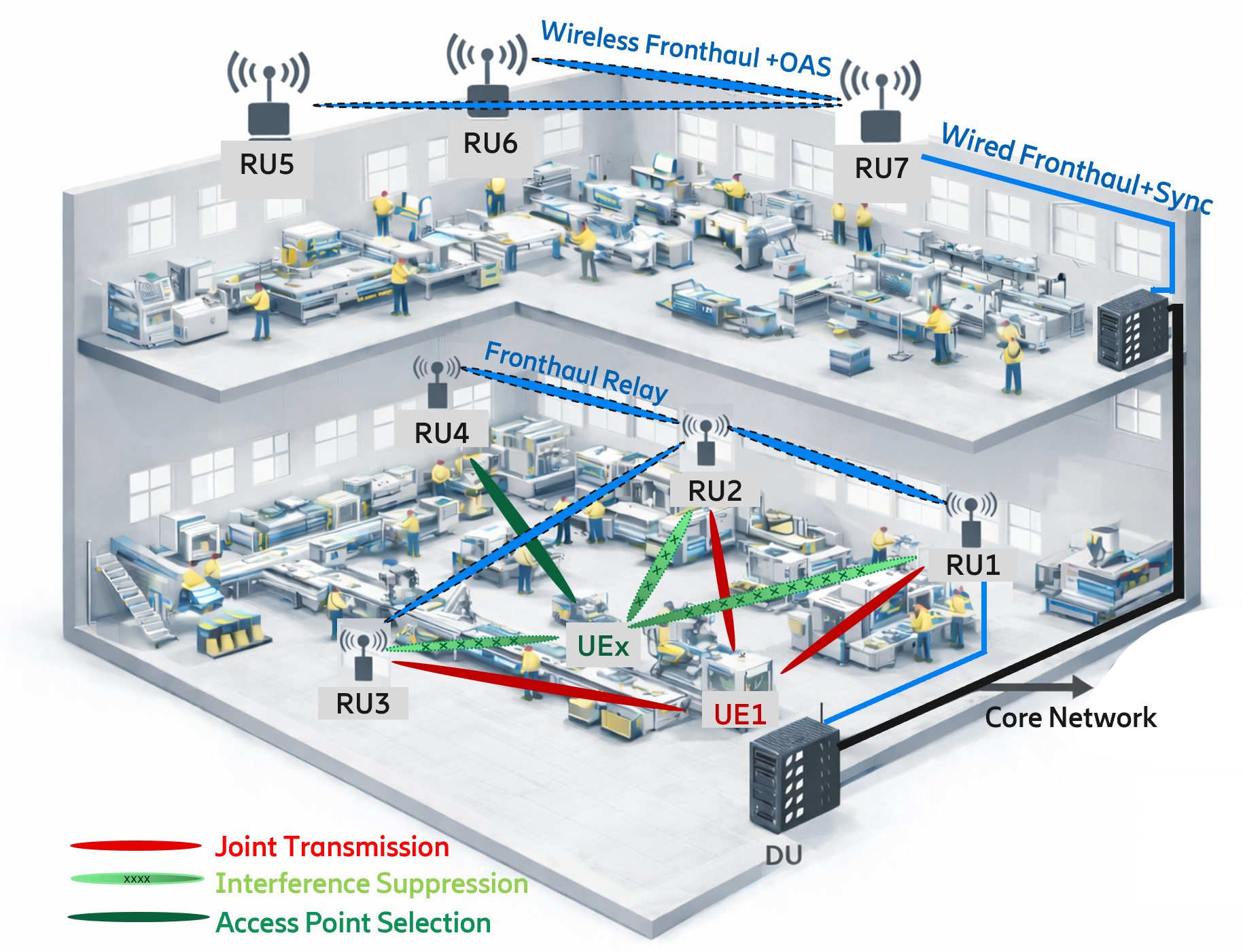
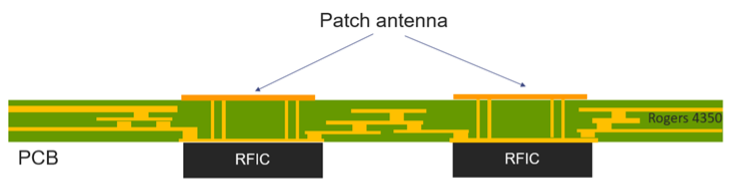
Cross-section of a part of the Printed Circuit Board (PCB) with with patch antennas on top and Radio Frequency Integrated Circuits at the bottom
This scenario relates to Industry 4.0/Manufacturing to provide accurate sensing and localisation integrated with communications. The required user data rates and area capacity are typically much lower than in an urban square scenario, so more resources can be devoted to providing accurate sensing. In this low Technology Readiness Level (TRL) hardware-oriented use case, we aim to demonstrate:
- Reuse of communication hardware for ISAC to assess feasibility and performance of passive radar-like sensing exploiting orthogonal frequency-division multiplexing waveforms.
The goal is to evaluate radar sensitivity and relevant hardware limitations focusing on the antenna and RF transceiver hardware. We will also leverage Time Modulated Array techniques to simultaneously transmit and/or receive sensing signals from multiple directions to simplify hardware and reduce power.
- Localisation exploiting frequency modulated array (FMA) techniques in the RU-hardware.
This involves two radio transceivers, such as localisation based on “active sensing” rather than passive reflections of radar radio-waves.
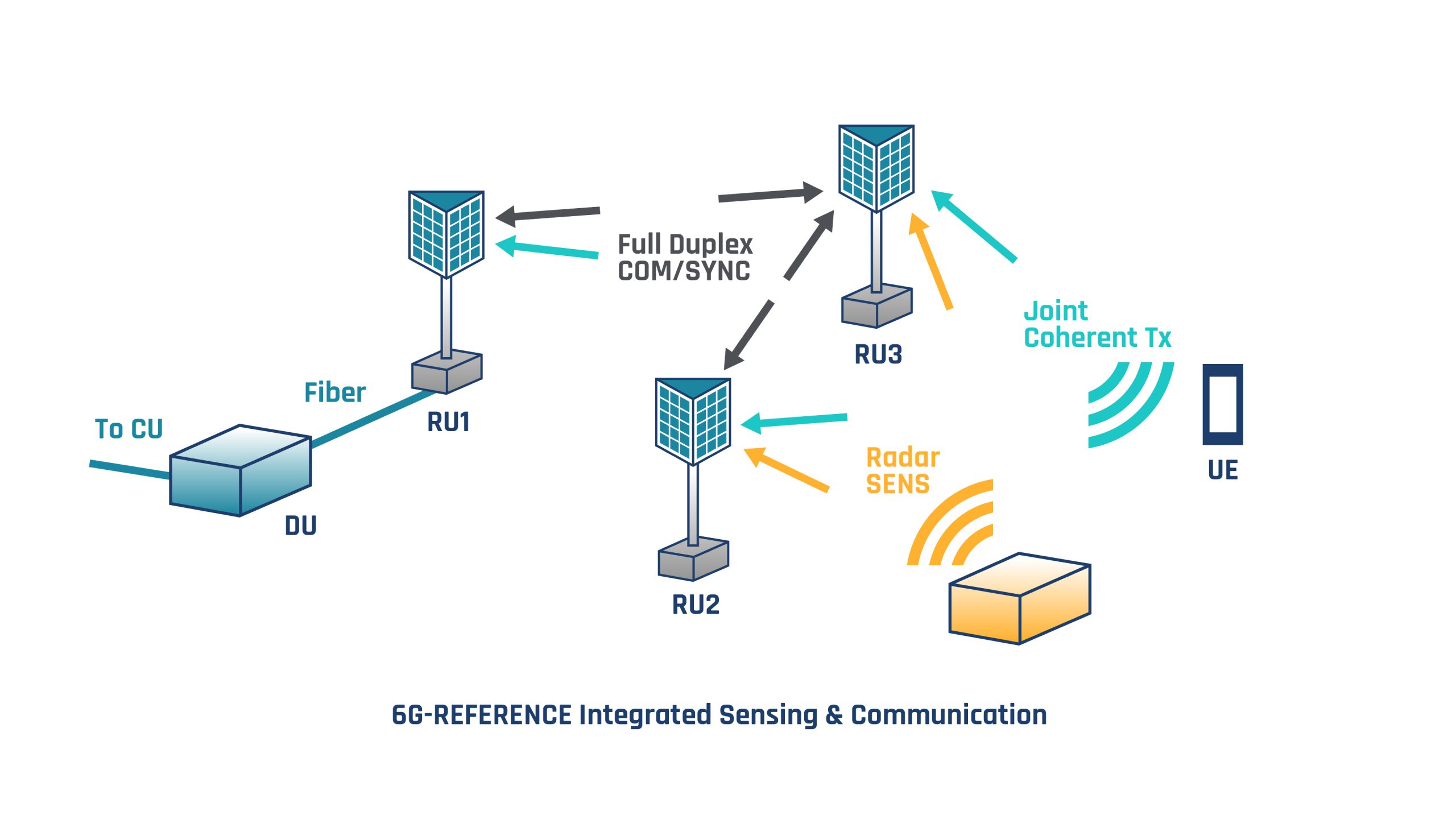
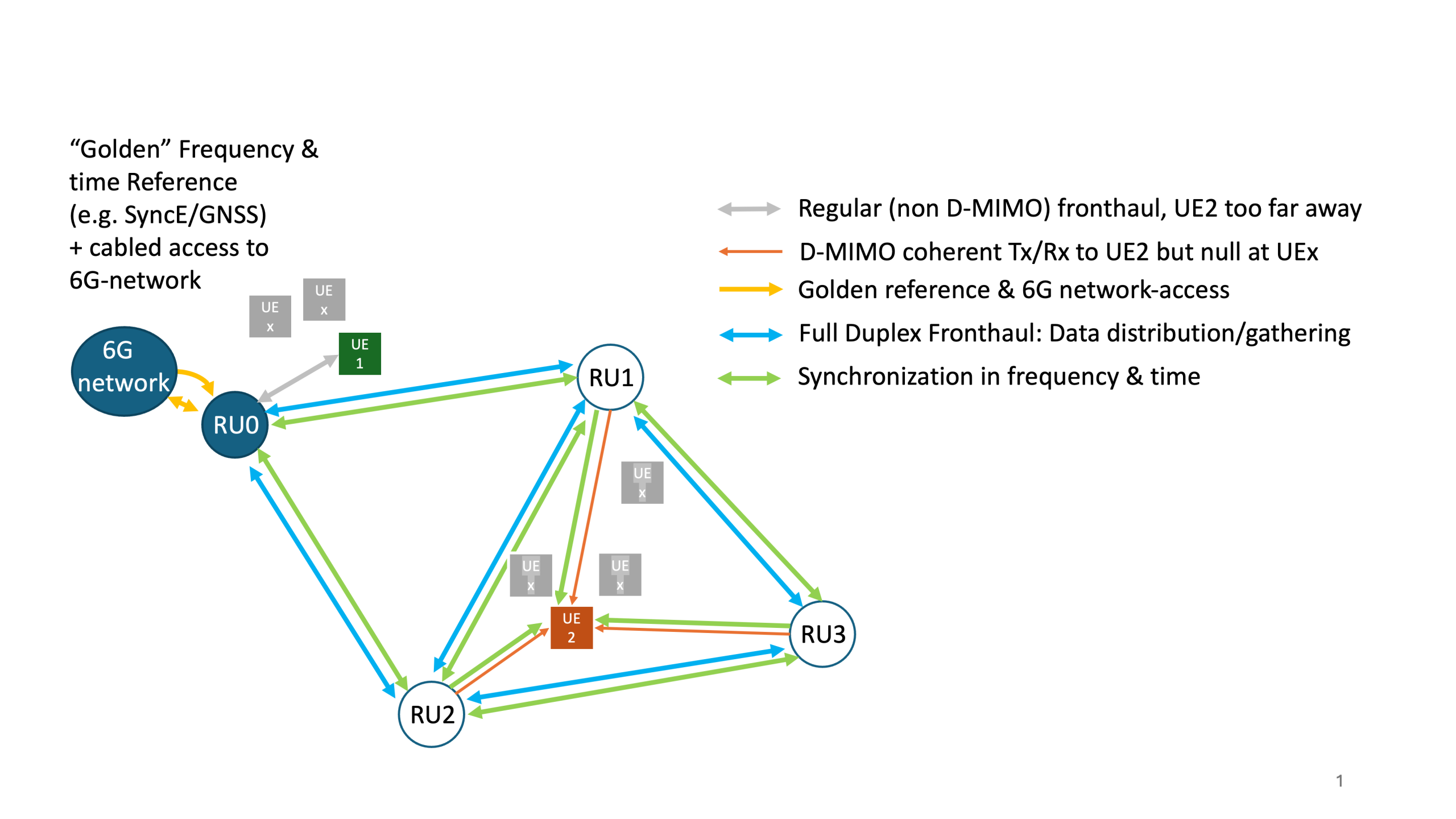
Schematic representation of the wireless Distributed MIMO Radio Units and the associated over-the-air synchronization and data-fronthaul links to the 6G-network
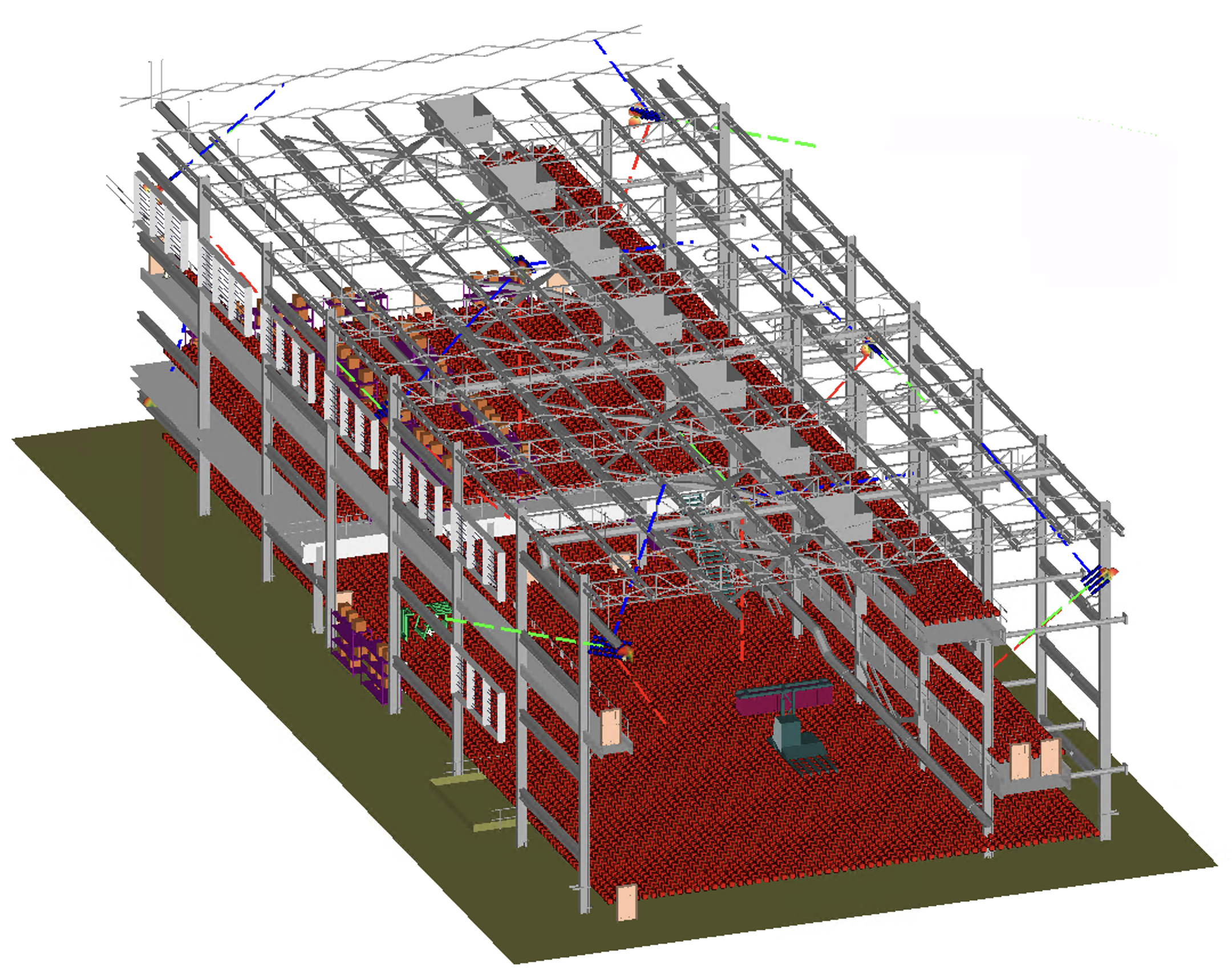
Factory hall used for Channel Impulse Response simulations to get multi-path data for the 14.8-15.35 GHz band for time synchronization simulations preparing for physical demos
The 6G-REFERENCE demos aim at TRL4, enabling systems providing communication services to workers and “intelligent industrial agents”, such as automated cranes, machines, robots and vehicles with low latency and more data capacity due to full duplex hardware capabilities. Our demo cases will:
- Provide fundamental accurate sensing services reusing the communication hardware for radar sensing (ISAC) and/or active localisation based on FMA
Complex scenarios mixing automated machines and human workers requires security measures to avoid collisions between machines and vehicles or accidents with workers. Therefore, sensing and localisation services here include detecting and tracking workers and mobile agents as well as predicting and avoiding collisions.
- Use sensing and localisation to monitor and control pathways and intersections shared by automated and human-driven vehicles and to assist the operation of robots with a high level of autonomy
Accurate synchronisation is key both for TSN, high data rate communication as well as accurate sensing.
Subscribe to our Newsletter!