
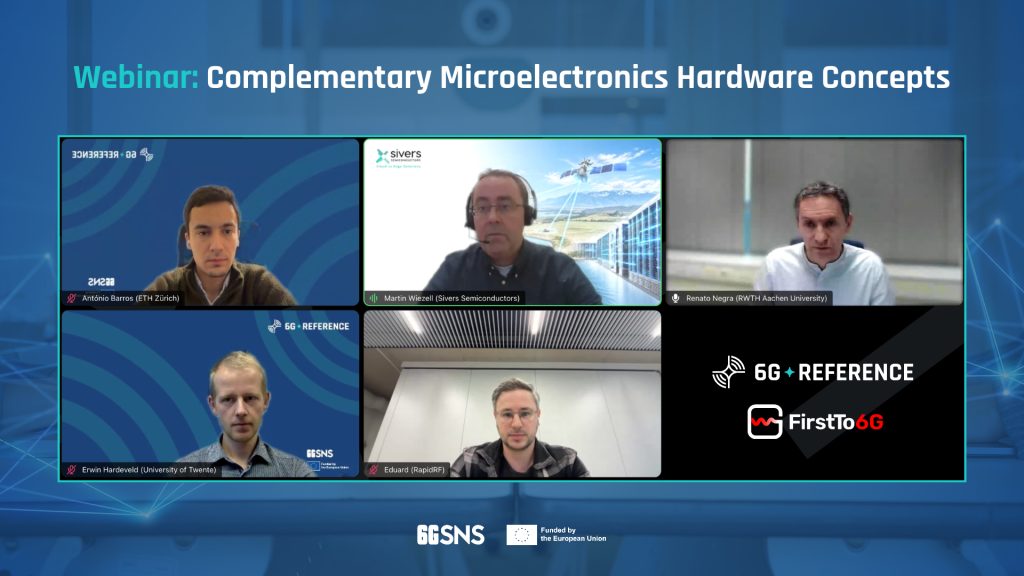
On 12 November 2026, 6G-REFERENCE and FirstTo6G came together for the second time to host a joint webinar on complementary microelectronics hardware concepts for 6G. Over 40 participants joined the session, which brought together researchers and engineers from both projects to share the latest technical results and explore synergies between the two initiatives.
Both projects are part of the same Smart Networks and Services Joint Undertaking (SNS JU) stream “B-01-05: Microelectronics-based Solutions for 6G Networks”.
The webinar opened with a welcome from Renato Negra (RWTH Aachen University, FirstTo6G), who presented the agenda and introduced both projects. He also highlighted the technical themes of the session: advanced hardware for integrated communication and sensing (ISAC), and the microelectronics challenges at the heart of 6G development.
The 6G-REFERENCE Presentations
A new approach to frequency generation · Erwin Hardeveld, University of Twente
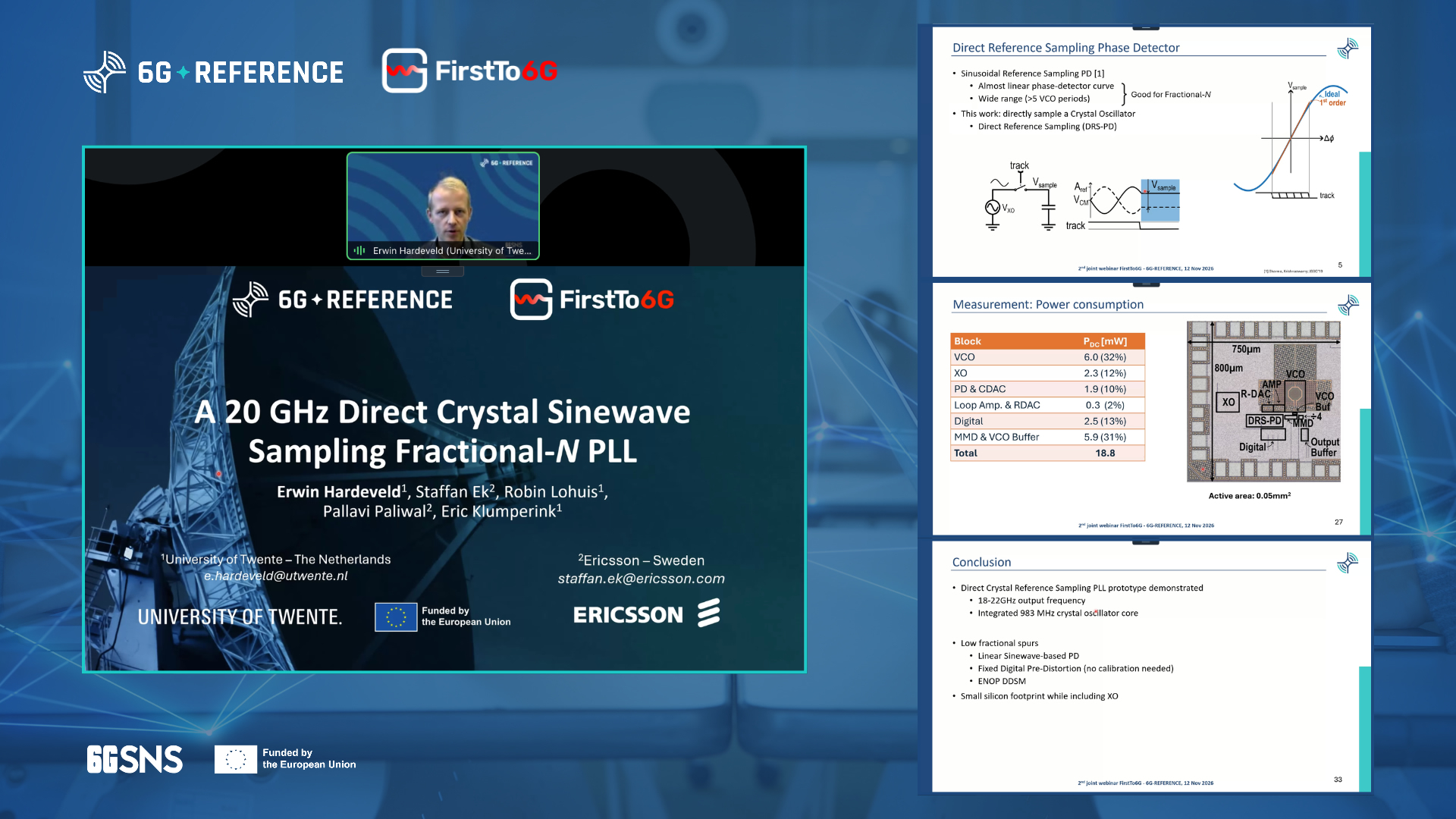
Erwin Hardeveld, Researcher at the University of Twente, presented his work on a direct referencing sampling phase detector, a key component in a 20 GHz fractional-N phase-locked loop (PLL) designed for high-purity RF signal generation.
As Erwin explained:
“This presentation shows the design of a low-jitter and low-spur 18–22 GHz frequency generator in 22nm FDSOI technology. High-purity radio frequency (RF) clocks are important for communication systems, as these enable high data-rate communications. This design relies on a high-frequency 983 MHz crystal oscillator reference which is directly sampled by the frequency generation circuit. With this approach, the amount of components between the reference signal and phase detector is minimised, which both reduces the noise and non-linearity, allowing us to demonstrate state-of-the-art −65 dBc fractional spur levels and <150 fs jitter.”
Smarter signal estimation under real-world conditions · António Barros, ETH Zürich
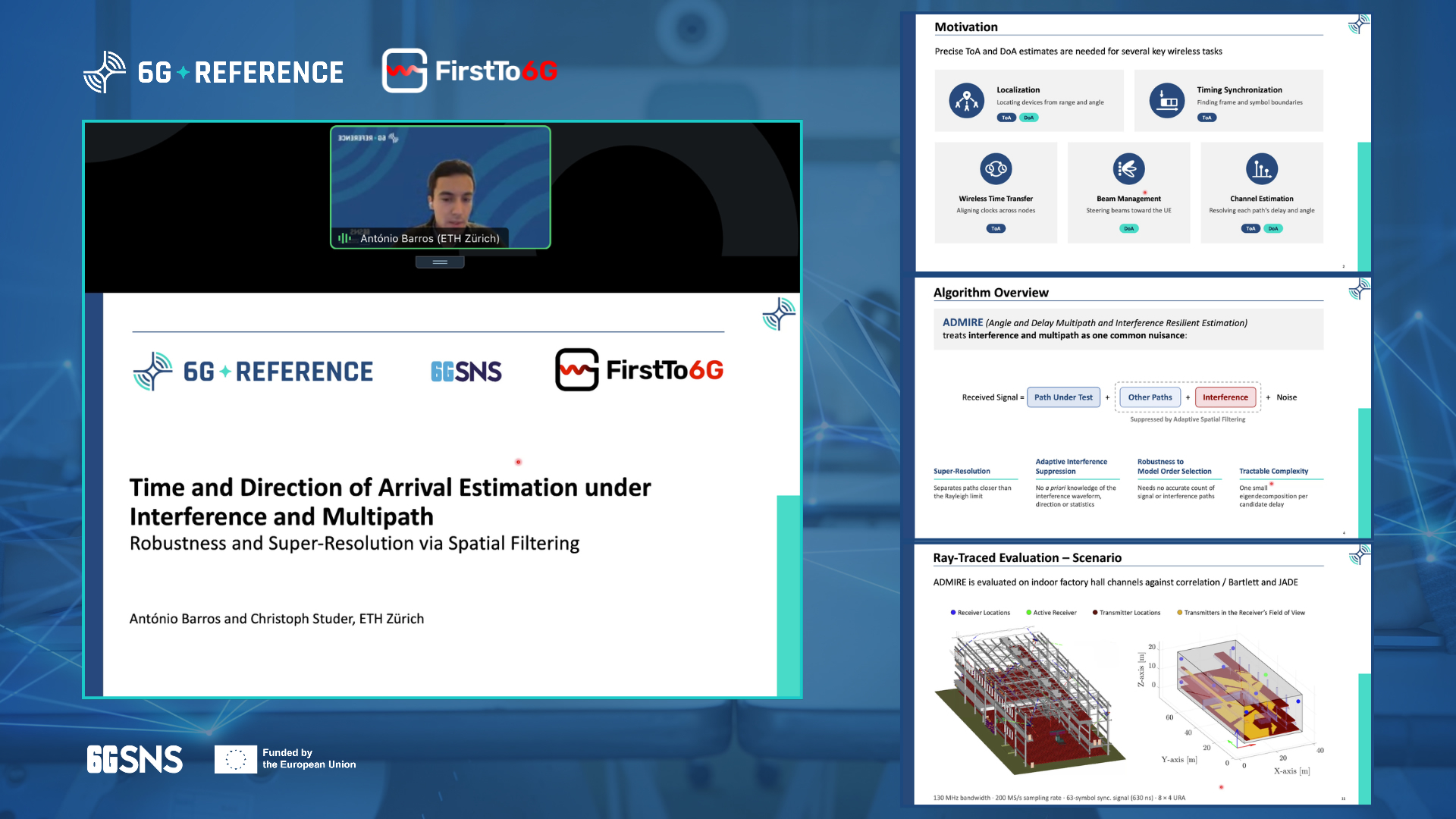
António Barros, PhD Student at ETH Zürich, introduced ADMIRE, an algorithm developed to estimate the time and direction of arrival of wireless signals in challenging environments, where interference, jamming, and multipath propagation are common obstacles.
In his own words:
“In this talk, we presented ADMIRE, a method for estimating the time of arrival (ToA) and direction of arrival (DoA) of wireless signals under strong interference and multipath. These estimates are essential for a range of wireless tasks, including synchronisation, wireless time transfer and positioning. In many real-world scenarios, interference and jamming can bury the received signal, while multipath can bias both the delay and the direction estimates. ADMIRE suppresses both with adaptive spatial filtering at a multi-antenna receiver, requiring no prior knowledge of the channel or the interference and no accurate count of the propagation paths or interferers.”
António also explained that for a setup with 130 MHz of bandwidth, an 8×4 antenna array and 30 dB SNR, ADMIRE can resolve paths just 1.1 ns apart in delay, compared with 8.7 ns for conventional correlation-based estimation. He also showed that the algorithm’s advantages hold up in realistic ray-traced indoor-factory environments. There, for signal-to-interference ratios as low as −20 dB, it estimates ToAs more accurately than correlation and line-of-sight DoAs more accurately than Bartlett beamforming, and it outperforms the subspace-based joint angle and delay estimation (JADE) method in both, while remaining computationally tractable.
The FirstTo6G Presentations
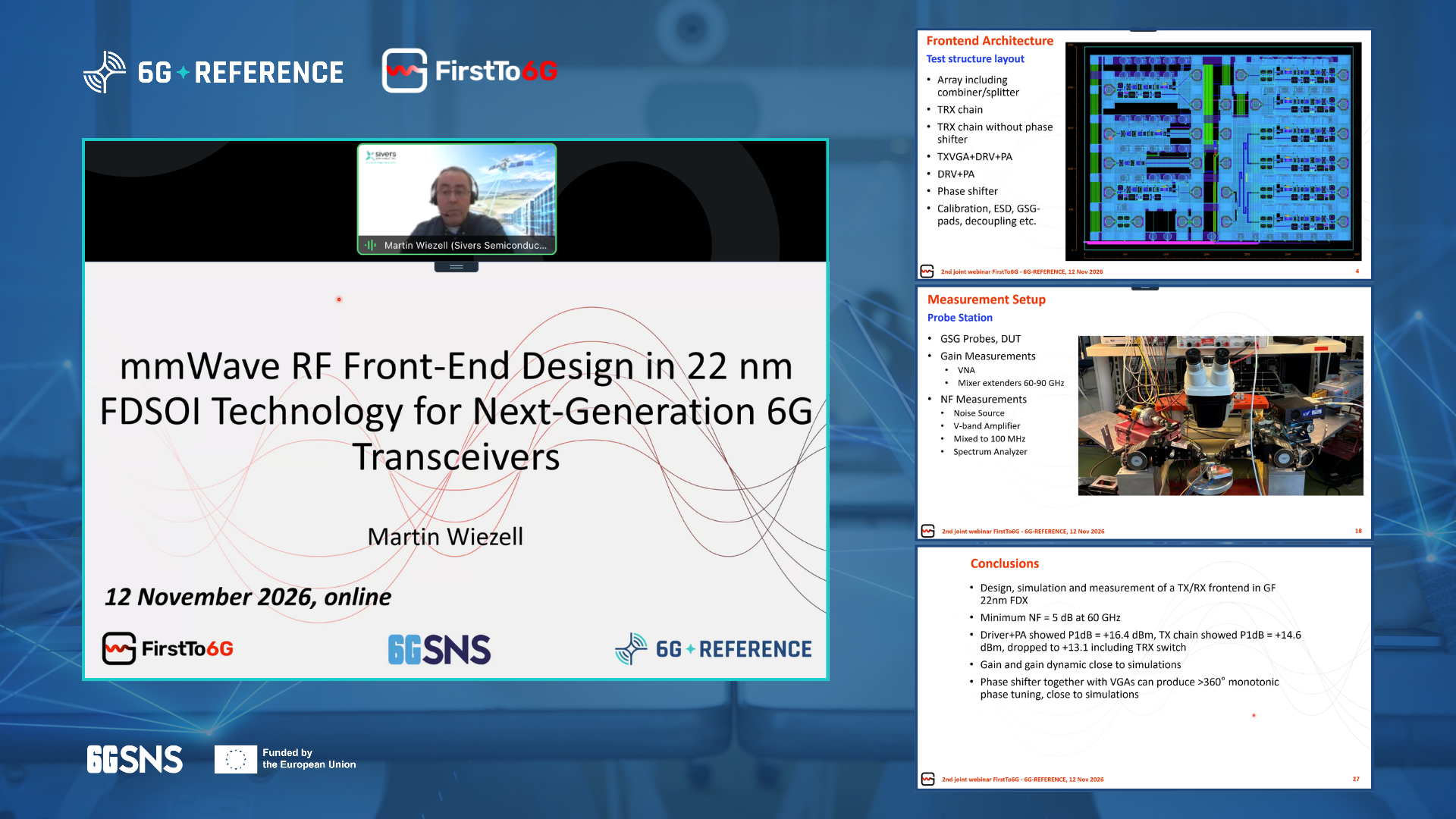
Millimetre-wave front-end design · Martin Wiezell, Sivers Semiconductors
Martin Wiezell, Senior Design Engineer at Sivers Semiconductors, presented work on a millimetre-wave RF front-end developed in 22nm FDSOI technology, targeting the 57–71 GHz band for 6G transceivers. He walked through the frontend building blocks, simulation results for both the RX and TX chains, including phase shifter and gain control simulations, and shared early measurement results from the probe station setup.
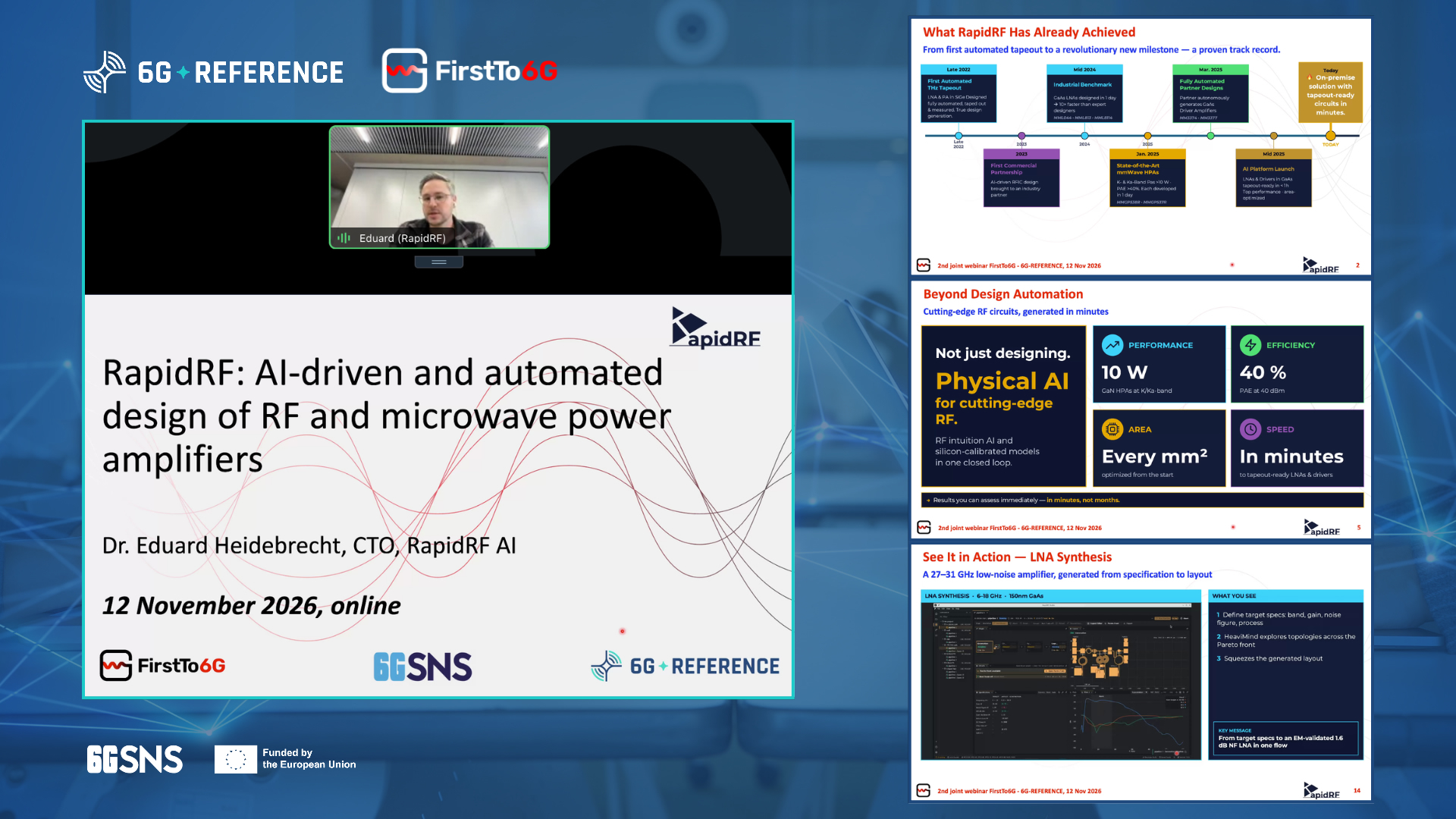
Automating RF design · Eduard Heidebrecht, RapidRF
The final presentation came from Eduard Heidebrecht, Co-Founder at RapidRF, who gave an overview of RapidRF’s automated design tool for RF and microwave power amplifiers. He addressed a key question in the field: why RF design has resisted the automation that has transformed digital and analogue design, and explained how RapidRF is working to change that.
The webinar concluded with a panel discussion moderated by Renato Negra exploring the synergies and potential collaboration between the two projects, with active participation from speakers and attendees.